
The Game of Conkers: History and Rules
Did you play conkers in the playground as a child, or do you supervise conker activities now as a forest school leader?
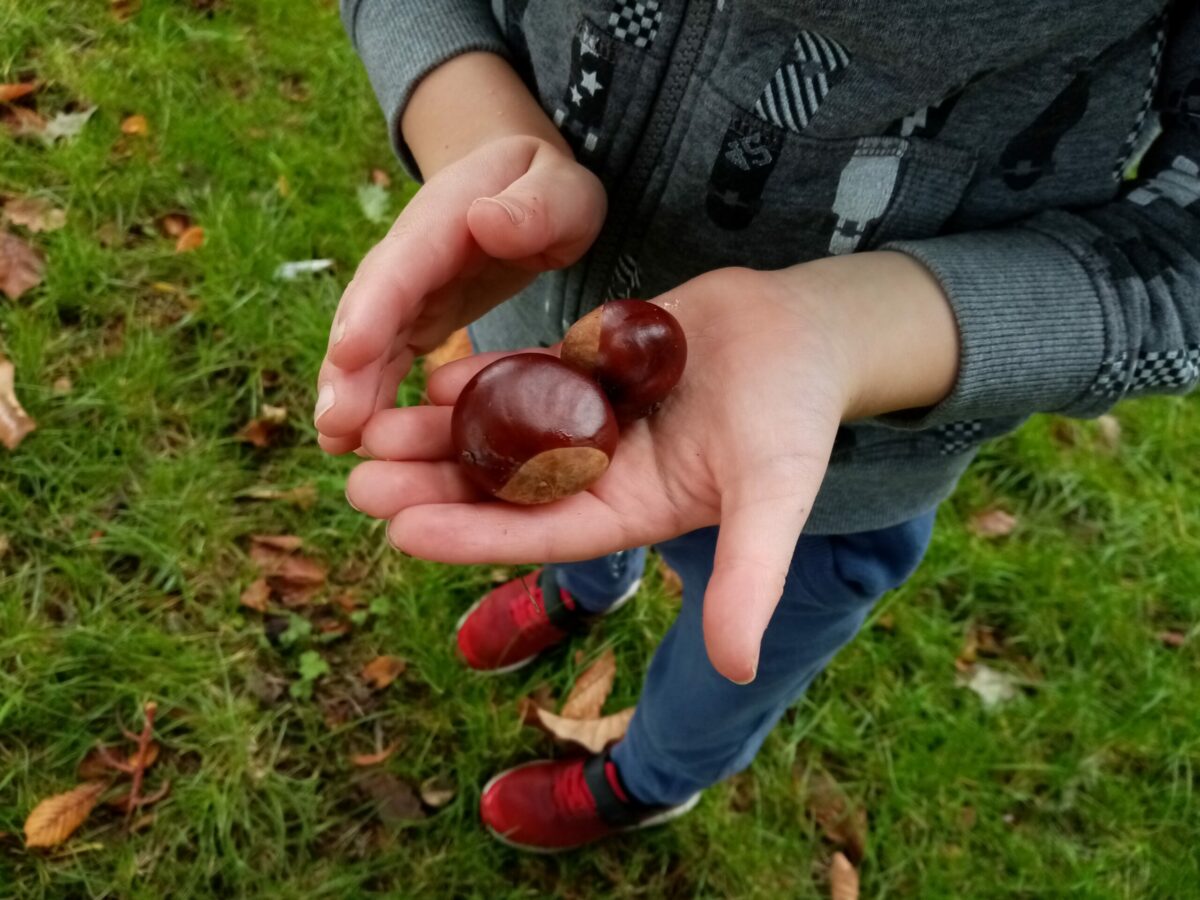
Given that all you need is a conker and some string (plus the kit to make the hole and thread it), the game has a pretty interesting history.
A game that started because fishing was bad
The World Conker Championships, still the closest thing the game has to an official governing body, began in 1965 at Ashton in Northamptonshire — started, by most accounts, by a group of anglers who couldn’t fish because of bad weather and improvised a contest with conkers instead. It ran in that village for 45 years before outgrowing the site and moving to nearby Southwick in 2009, where it’s still held every October (more on the championships’ history here).
What started as a wet-afternoon distraction now draws players from well outside the UK — Australia, Canada, Japan, the United States and several European countries have all sent competitors — and has raised well over £400,000 for charity along the way.
How far the game actually goes back
The championships gave conkers its modern, organised form, but children were threading horse chestnuts onto string and knocking them together long before 1965!
The game is generally reckoned to date to the mid-1800s in Britain, and earlier versions used snail shells or hazelnuts before horse chestnuts, introduced to Britain from the Balkans in the late 16th century, became widely available and turned out to work better.
The rules, if you want to play it properly
Conkers is one of those games everyone half-remembers the rules to and nobody plays quite the same way twice. And that’s fine! As long as everyone playing has the same understanding, it’s fine to let children make up their own version of the rules.
The championship version is more formal than most playground games, but it’s a useful reference point if someone wants more guidance on what they ‘should’ be doing:
- Each conker is threaded onto a piece of string roughly 20cm long, knotted at one end.
- Players take turns striking their opponent’s conker, each getting three swings per turn.
- A “conker” is when your conker strikes and damages your opponent’s.
- If the strings tangle, whoever shouts “strings” first gets an extra turn.
- If a conker is knocked off its string entirely but not smashed, the player can claim it as a “won” conker if they pick it up before their opponent’s foot does.
- A conker’s win count carries over. A conker that has smashed one opponent becomes a “one-er,” and its tally climbs with each win, absorbing the beaten conker’s own prior score.
Playground versions we’ve come across tend to drop the tangled-string rule and the score-carrying system entirely, which is fine — the version that keeps children engaged for the length of a session is the right version.
And I would strongly recommend eye protection if you’re going all out on the smashing! Make sure your risk assessments are updated and relevant, and take whatever precautions are necessary. There are more safety notes below (and I’ll say here that we don’t do this activity in our setting).
An alternative to the smashing is a throwing activity, which you can read more about in our round up of conker activities (no eye protection required!).
Preparing conkers without cheating
Competition rules ban baking, soaking in vinegar, or varnishing conkers to harden them — all traditional playground tricks for producing a “twenty-two-er” that survives everything thrown at it.
Read next: Why do conkers shine? (Because the duller they are, the harder they are, good to know for the game!)
For a school session, we’d skip the debate about what counts as cheating altogether and just let children choose their own conker on its size and shape (maybe while out on an autumn scavenger hunt), which keeps the focus on the game rather than pre-match preparation.
Running it as a group activity
Conkers works well as a forest school session precisely because the equipment is free and the rules scale to whatever group size turns up. A few adjustments that have worked well for us in the past:
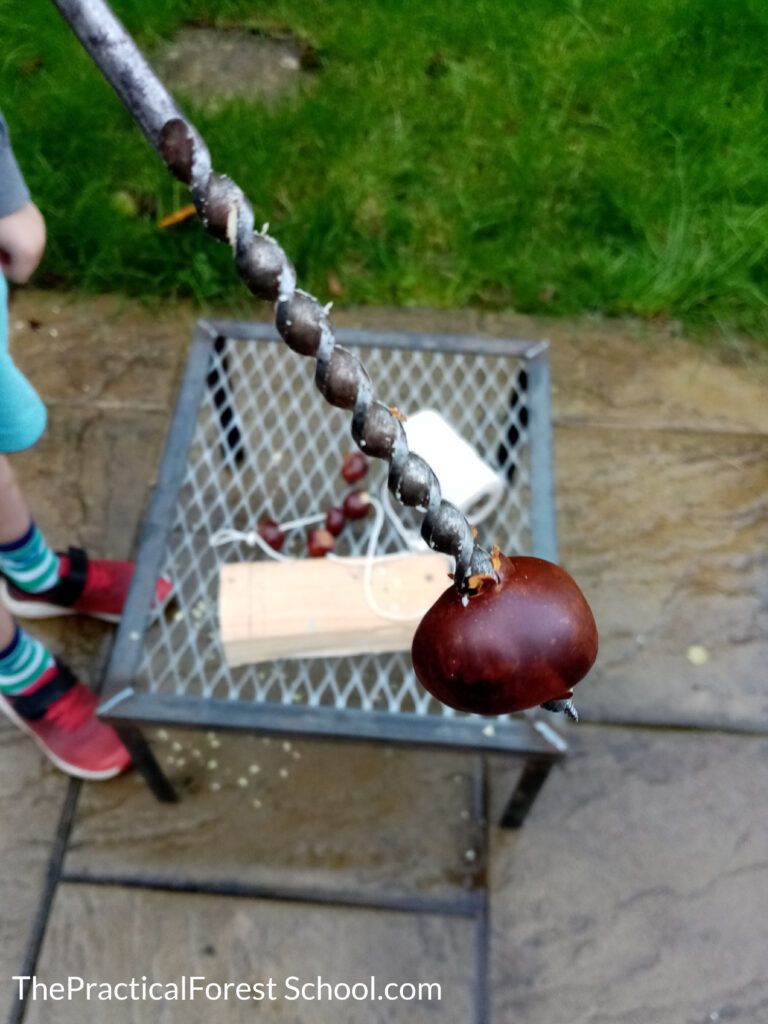
- Pre-drill the conkers before the session (a bradawl or small drill bit through the centre) so time isn’t lost to fumbling with a shoelace and a stubborn nut.
- Pair children by rough size or age rather than entirely at random, so early rounds don’t end in one obviously outmatched pairing after another.
- Run a simple knockout bracket for groups who want the competitive structure, and a free-play area alongside it for anyone who’d rather just bash conkers without the scoring.
- Have spare string and spare conkers ready — strings snap, and a child mid-game whose conker has just shattered wants a replacement quickly, not a lecture on preparation.
Safety notes for your risk assessment
Conkers is not as high risk as fires and knife work by forest school standards, but it isn’t a no-risk one.
It’s not a game we play in our setting for exactly that reason, as I said above, but you can make your own decision about whether you think it’s an activity worth making available in yours.
Flying shell fragments and the occasional stray knuckle strike are more common than you might think, and overenthusiastic game play is almost always (in our estimation) going to leave to someone going home with a bruise.
So, if this really is something you want to do…
- Keep a sensible distance between pairs playing simultaneously, so one game’s fragments don’t become another pair’s problem.
- Basic eye awareness is worth a mention before play starts. Use eye protection and do your risk assessments!
- Check for allergies before handling shells and casings, as with any natural material session — horse chestnut isn’t a common allergen, but it’s a quick check worth building into your routine.
There are plenty of other autumn forest school activities you can do, if you think a game of conkers is not right for your setting!

About the author: Jon Borley
Jon qualified as a Level 3 Forest School Leader with the Sussex Wildlife Trust. He has worked independently as a practitioner running forest school clubs and also within schools both in a forest school capacity and as an outdoor learning teaching assistant, working with preschoolers to secondary-aged children. He has previously led sessions for adults as part of professional development events for the Sussex FSA, and is a member of MIAS.