
What Is a Forest? The Surprisingly Tricky Definition
Ask a child to draw a forest and you’ll get trees, probably too close together, possibly a bear. Ask an ecologist, a government forestry department and a forest school leader the same question, and you’ll get three different answers!
“Forest” is one of those words everyone understands and almost nobody agrees on. So what exactly is a forest?
The official definition
The UN’s Food and Agriculture Organization, which sets the definition most governments use for reporting purposes, defines a forest as land over 0.5 hectares where trees can reach at least 5 metres in height and canopy cover exceeds 10%, and which isn’t primarily used for agriculture or urban development. You can read the full FAO definition here.
That threshold is lower than most people expect. A 0.5-hectare patch of scrubby young trees with gaps between the canopies technically counts. A dense, ancient orchard, planted purely for fruit, technically doesn’t — it’s excluded as agricultural land regardless of how tree-covered it looks.
Woodland, forest, wood: is there a difference?
In everyday UK usage, no. “Wood,” “woodland” and “forest” get used more or less interchangeably, and there’s no legal distinction in casual speech. Foresters sometimes use “woodland” for smaller or more managed areas and reserve “forest” for larger, wilder expanses, but it’s not really a rule.
Historically, “forest” meant something narrower and stranger: a royal hunting ground, which didn’t have to be wooded at all. The New Forest in Hampshire is the best-known survivor of that older sense — plenty of heathland, relatively few trees, and still called a forest because of what it was legally set aside for, not what grows there.
What “forest” means inside forest school
Forest school, as a term, doesn’t actually require a forest (wild, right?!). The Forest School Association describes it as “a child-centred inspirational learning process” delivered through regular sessions in a natural setting.
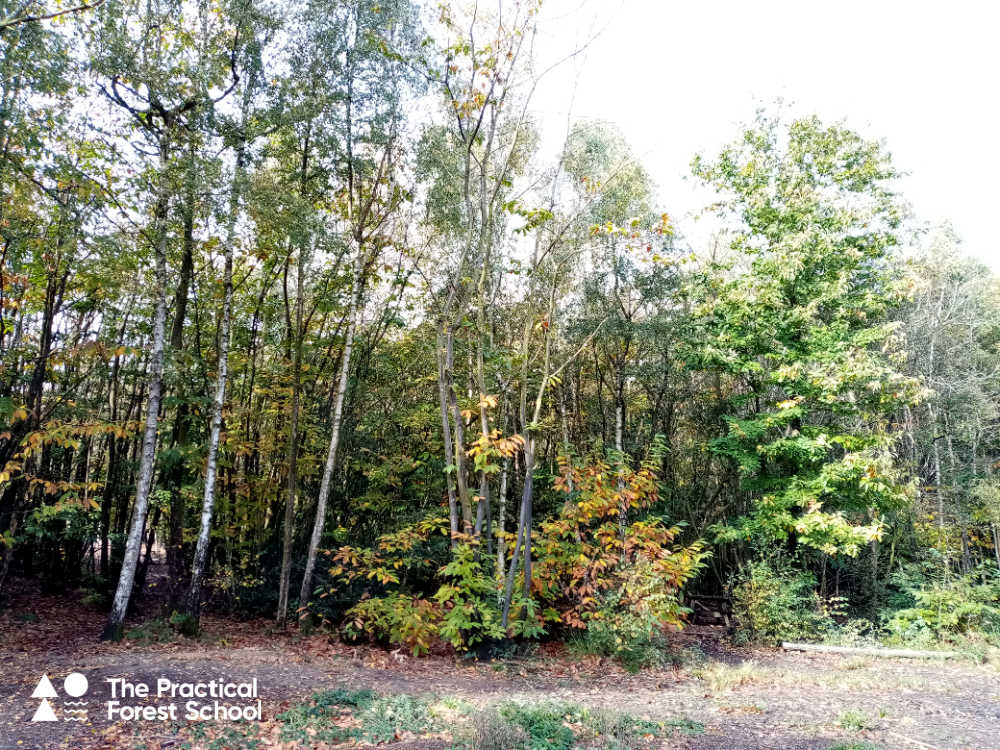
In practice, that setting is very often a small copse, a scrubby corner of school grounds (yep, been there!), or a handful of mature trees rather than anything the FAO would count.
The name comes from the Scandinavian friluftsliv tradition — “open-air life” — that the approach was adapted from when it arrived in the UK in 1993, not from a requirement that sessions happen in dense, extensive woodland.
Luckily for us, that means forest school can reach a lot more people.
- Schools without access to real woodland can still run a forest school programme, provided the site offers trees, natural materials, and room for supported risk-taking.
- The pedagogy is the definition, not the acreage. A pocket of five trees used well over a long-term programme is more “forest school” than a vast plantation visited once.
- Parents researching provision locally shouldn’t rule out a setting just because it looks modest in photos. Ask about the programme structure and leader qualifications instead of the tree count!
Why the mismatch exists
The FAO’s definition exists to standardise land-use statistics across very different countries, so it has to be blunt and measurable — height, cover, area. Forest school’s use of “forest” borrowed the word for its associations with nature, freedom and the outdoors, at a point when the movement was naming a learning philosophy, not surveying land.
Both are legitimate uses of the same word doing different jobs, which is a slightly unsatisfying answer but the honest one!
Other definitions worth knowing
The UK’s own forestry bodies don’t always use the FAO figures either. The Forestry Commission (now Forestry England in parts of the UK) has historically worked with different canopy-cover thresholds for national woodland surveys, and “ancient woodland” — land that’s been continuously wooded since at least 1600 in England and Wales — is a separate legal category again, protected regardless of how it measures up against any size or density threshold.
If you’re a school or using a setting near old hedgerows or small ancient copses: a site can carry real ecological and legal significance without coming close to qualifying as a “forest” under any of the technical definitions above.
So are we any closer to a strict, single-version-of-the-truth definition of a forest? Not really!
Why children ask the question at all
“Is this a forest or just some trees?” is a question we’ve heard often enough in outdoor sessions that it’s worth having a straightforward answer ready rather than an evasive one. Our usual response has been some version of: “It doesn’t matter much what we call it, what matters is what we do here.”
I know it sounds like a dodge, but it reflects how the forest school approach actually works. A handful of trees that we meet under consistently, with a group that returns to the same spot term after term, is more aligned to forest school practice than a single visit to somewhere technically forested. And there are probably fewer worksheets involved too!
A short version for a classroom wall
If a definition is needed for a display or a worksheet, a workable child-friendly version might be: a forest is a large area where trees grow close enough together that their branches and roots shape the whole environment underneath them — the shade, the soil, and what else can grow or live there.
It’s not exact, but it captures the idea for a primary audience!

About the author: Jon Borley
Jon qualified as a Level 3 Forest School Leader with the Sussex Wildlife Trust. He has worked independently as a practitioner running forest school clubs and also within schools both in a forest school capacity and as an outdoor learning teaching assistant, working with preschoolers to secondary-aged children. He has previously led sessions for adults as part of professional development events for the Sussex FSA, and is a member of MIAS.