
Cooking in the Forest: What We’d Recommend for a First Session
Why cooking is the session everyone remembers
Ask any group of children a term after a forest school programme what they remember, and campfire cooking usually beats den building, knots, and whatever craft activity took the most preparation to set up. There’s something about eating food you’ve cooked yourself, outdoors, slightly smokier than intended, that sticks.
It’s what we heard most of all when we were running forest school sessions: “Will there be marshmallows?”
That said, it’s also one of the sessions with the most that can go wrong if it’s rushed, which is why we’d always recommend starting simple.
Getting the basics right
Food cooked outdoors carries the same risks as food cooked anywhere, plus a few extras — inconsistent heat, less reliable temperature checking, and ingredients that have usually spent longer out of a fridge than they would at home.
A few non-negotiables, in line with guidance the Forest School Association publishes:
- Keep raw food cold until it’s needed, and don’t let it sit out “getting ready” for longer than necessary.
- Cook food thoroughly. Meat and eggs need to reach a proper internal temperature, not just look done on the outside. We avoid these ingredients in after school clubs and short sessions because there are plenty of better options that don’t carry a risk.
- An adult stays at the fire at all times once it’s lit, and children only approach when invited.
- Keep a container of water next to the fire circle for putting it out.
What to cook first
For a first cooking session, we’d steer away from anything that needs precise timing or a hot enough fire to be forgiving of mistakes. Good starting points:
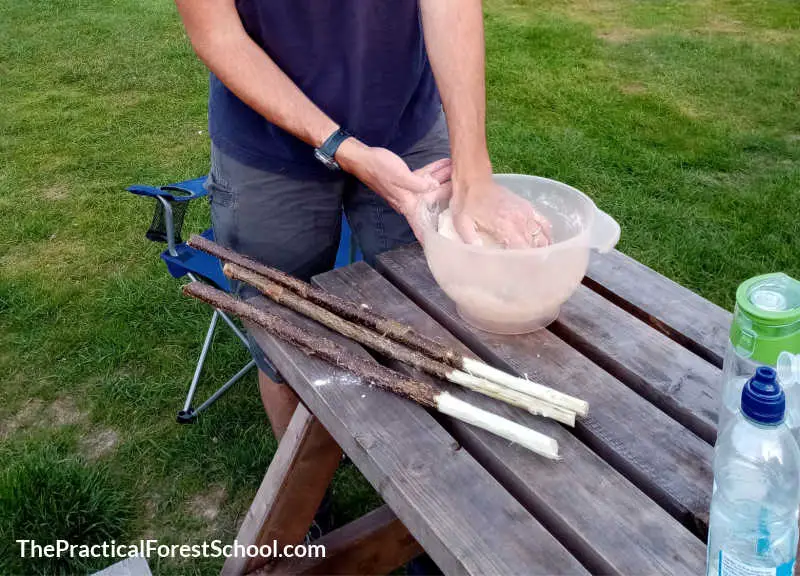
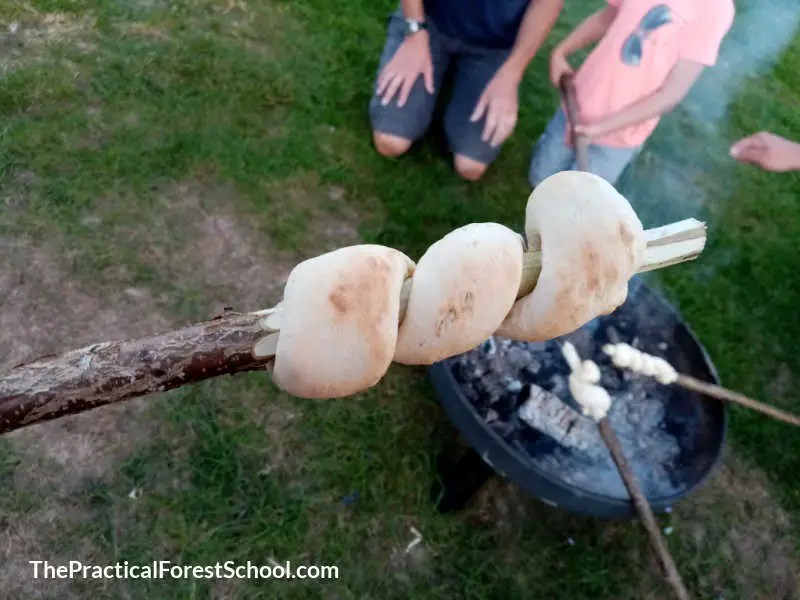
- Bread twists — a simple dough wrapped around a stick and held over embers. Forgiving, quick, and satisfying even slightly burnt.
- Foil-wrapped vegetables pushed into the edge of the embers, where the heat is gentler and more even than directly over flame.
- Popcorn in a lidded pan over the fire, mostly for the noise and drama rather than nutritional ambition!
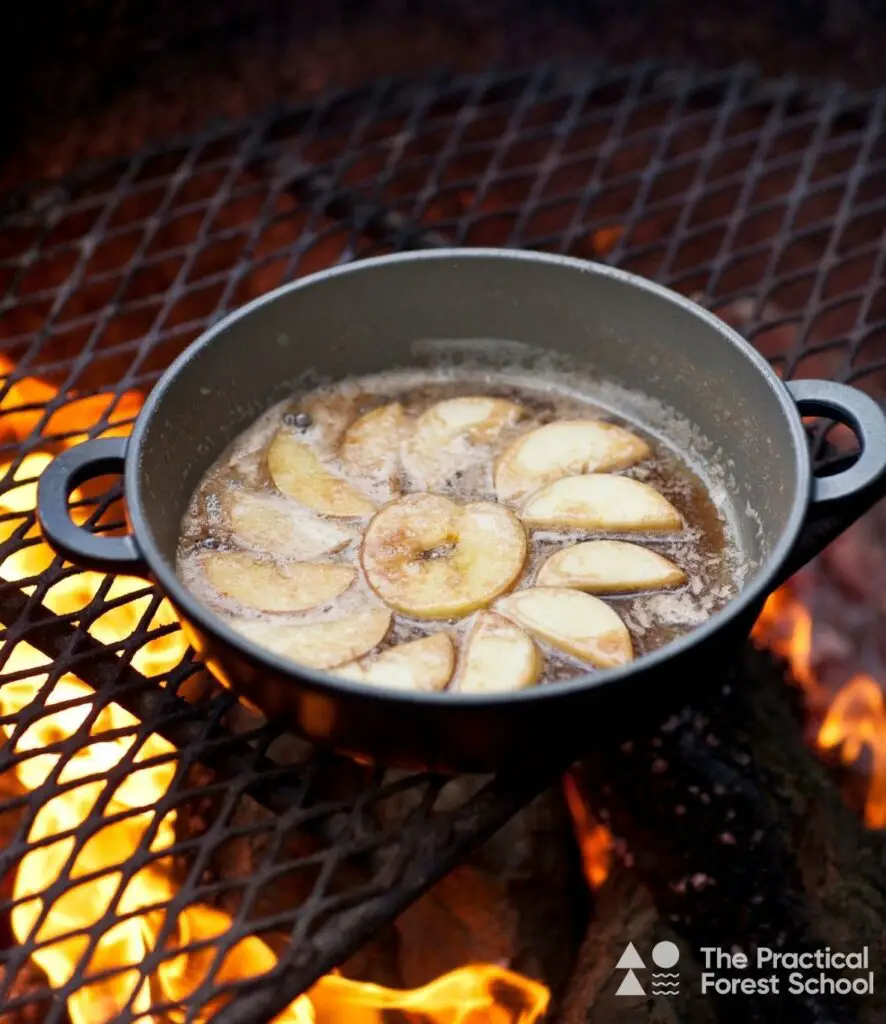
- Marshmallows or apple slices, for a low-stakes finish that can be dipped in cinnamon sugar for an extra sugar rush!
We have had a lot of interest and success in making campfire bread, bread on a stick, damper bread or whatever you want to call it. And it works well with gluten free flour and mix ins like chocolate chips.
Sausages and anything meat-based are worth saving for a second or third session (if at all), once the group understands fire discipline and you and any other adult helpers are confident reading which children need closer supervision near the flames.
Check out our collection of winter recipes for the fire circle for other ideas.
Setting up the fire circle
A cooking fire is a little different from a fire lit purely for warmth or atmosphere:
- Clear the fire circle of leaf litter and debris well beyond the ring of logs.
- Build the fire to burn down to steady embers before cooking starts — flames look good but cook unevenly and are more dangerous to work close to.
- Keep tools, skewers and pans in a fixed spot so nobody’s improvising with whatever stick is nearest the fire.
- Agree the “fire circle rule” with the group before lighting anything: nobody crosses the log boundary without being invited.
We use a Kelly Kettle for hot water because it’s a lot less risky than an open pan. Complete your risk assessments and make sure you’re only doing what is within the possibilities of your site.
And of course, no fires during dry spells where there’s a risk of a spark causing a much bigger problem.
The bit that’s easy to underestimate
Handwashing gets forgotten outdoors more than it would indoors, simply because there’s no sink in sight. A jerry can of water and biodegradable soap, positioned well away from the fire, solves this. It’s worth building the pause into the session plan rather than trusting it’ll happen naturally. Because from our experience, it won’t!
Cooking sessions are also one of the easiest to link back to the National Curriculum. You can cover food hygiene, states of matter, and where ingredients come from.
Managing the group, not just the fire
The practical fire-safety side of a cooking session tends to get most of the attention in planning, but managing the group around a shared, limited resource — one fire, a handful of pans, twenty children — is often the harder part on the day.
A few approaches schools we know have found useful:
- Rotate small groups through the cooking area rather than gathering everyone around the fire circle at once.
- Give the children waiting their turn a parallel task like collecting kindling, preparing ingredients, or a related nature activity, rather than standing idle near the fire.
- Assign one adult specifically to fire supervision with no other job, separate from whoever is managing the wider group.
You need enough people to make fire-based activities possible, so watch your ratios.
Weather and timing
Cooking sessions are more weather-dependent than most other forest school activities. Building in a fallback — a no-cook activity that can run instead, or a later-in-the-day slot with more flexibility — avoids the whole session collapsing around one uncooperative fire.
Dry, sheltered kindling stored from a previous visit is worth its weight when a site has had a wet week. A tin of char cloth or commercial firelighters as backup is a sensible, low-effort insurance policy.
It’s not a failure to not light a fire in a “forest school way”. Just use a match! You can always teach dragon snifters or batteries in a different session.
Equipment worth having on hand
- A folding grill or trivet, so pans aren’t balanced directly on logs
- Long-handled tongs, so nobody’s reaching close to embers with bare fingers
- A dedicated chopping board and knife kept only for food prep, separate from any bushcraft tools
- Wet wipes or a second water supply for quick hand-cleaning between food handling and fire tending
None of this needs to be expensive or elaborate. The sessions that work best tend to be the ones with a short, well-rehearsed routine rather than an ambitious menu. What will you cook first?

About the author: Jon Borley
Jon qualified as a Level 3 Forest School Leader with the Sussex Wildlife Trust. He has worked independently as a practitioner running forest school clubs and also within schools both in a forest school capacity and as an outdoor learning teaching assistant, working with preschoolers to secondary-aged children. He has previously led sessions for adults as part of professional development events for the Sussex FSA, and is a member of MIAS.